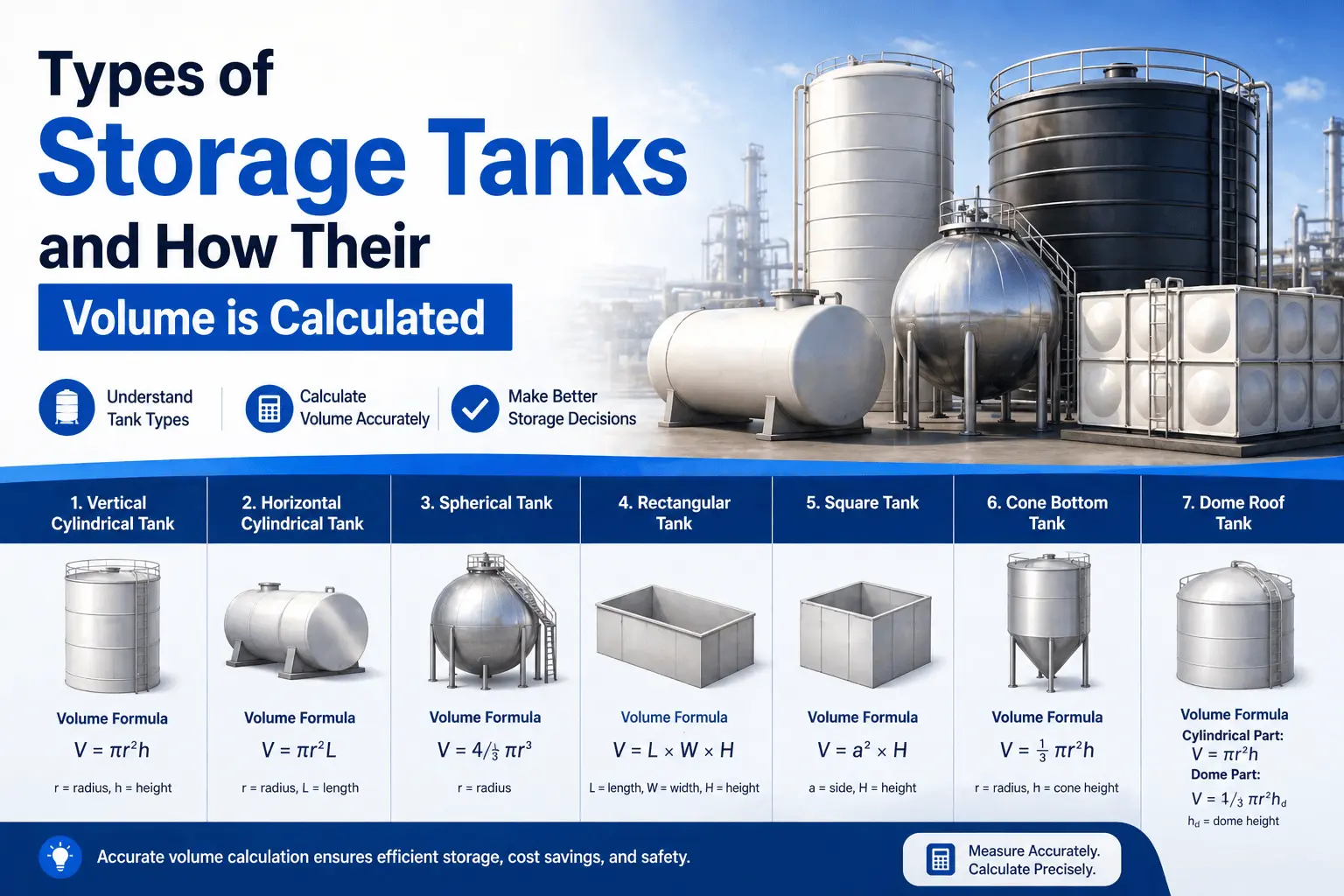
| Storage tanks come in more shapes and sizes than most people realise. From a small plastic water tank in a backyard to a massive cylindrical oil vessel in a refinery, each tank type follows a specific geometry and a specific volume formula. Knowing the differences helps you choose the right tank for your application and calculate its capacity correctly from the start. |
This guide covers every major type of storage tanks used in residential, agricultural, commercial, and industrial settings. For each tank type, we explain what it looks like, what it is used for, how its volume is calculated, and which calculator you can use to get an instant result without working through formulas manually.
An Introduction to Types of Storage Tanks
Storage tanks serve one basic purpose: holding a defined quantity of liquid, gas, or granular material safely and efficiently. Despite that simple purpose, the variety of tank types is enormous because different applications impose very different requirements on shape, material, pressure rating, and capacity.
A tank holding drinking water needs to be sealed against contamination, UV-stable if above ground, and easy to clean. A tank holding diesel fuel must resist chemical corrosion and comply with environmental regulations on secondary containment. A pressure vessel holding compressed gas needs to distribute internal stress evenly across its entire surface, which is why curved shapes dominate that sector.
Shape is the defining factor in tank volume calculation. Because each geometric shape encloses space differently, every tank type has its own formula. A cylindrical tank, a rectangular sump, and a capsule pressure vessel all calculate volume through completely different equations even when they hold identical quantities of liquid.
| Tank Type | Shape | Primary Use | Volume Formula |
| Vertical Cylinder | Round upright | Water storage, chemicals | V = pi x r2 x h |
| Horizontal Cylinder | Round on side | Fuel, oil, septic | V = pi x r2 x L |
| Rectangular | Box shaped | Underground sumps, pools | V = L x W x H |
| Capsule | Cylinder + two hemispheres | Compressed gas, pharma | V = pi r2 h + 4/3 pi r3 |
| Dish End | Cylinder + curved end caps | Industrial pressure vessels | V = cylinder + end caps |
| Elliptical | Oval cross section | Road tankers, rail wagons | V = pi x a x b x L |
| Round / Spherical | Perfect sphere | LPG, cryogenic storage | V = 4/3 x pi x r3 |
Storage tank design and construction is governed by internationally recognised standards. The American Petroleum Institute publishes the most widely cited guidelines covering large above-ground tanks. More information is available through the API Standards for Storage Tanks, which define construction, inspection, and capacity measurement requirements used globally.
Cylindrical Tanks: The Most Widely Used Storage Solution
Cylindrical tanks dominate storage applications across nearly every sector. The circular cross section distributes the pressure of stored liquid evenly around the tank wall, which means thinner material achieves the same structural integrity compared to flat-sided tanks. This makes cylindrical tanks cheaper to build per litre of capacity, structurally reliable, and easy to manufacture at any scale.
Vertical cylindrical tanks stand upright with the circular base on the ground. They are the standard shape for overhead water tanks, farm water storage, industrial chemical storage, and food processing vessels. Horizontal cylindrical tanks lie on their side and are standard for fuel storage, transport tankers, and septic systems.
| Vertical Cylindrical Tank The global standard for water and chemical storage |
| Formula: V = pi x r2 x h r = radius of the circular base (half the diameter) h = internal height of the tank Result in cubic meters when r and h are in meters Multiply by 1000 to convert to litres Common uses: Overhead water tanks, irrigation storage, chemical vessels, food processing tanks, fire water storage |
| Worked Example: Vertical Cylinder |
| Diameter: 2 m so r = 1 m Height: 4 m V = 3.14159 x (1)2 x 4 V = 3.14159 x 4 = 12.566 m3 Volume = 12,566 litres Result: 12,566 litres (12.57 cubic meters) |
| Horizontal Cylindrical Tank Standard shape for fuel storage and transport |
| Formula: V = pi x r2 x L r = radius of the circular cross section (half the diameter) L = internal length of the tank along the horizontal axis For partial fill calculations a trigonometric formula is required Common uses: Diesel and petrol storage, road tankers, underground petroleum tanks, septic tanks, oil storage |
| Worked Example: Horizontal Cylinder |
| Diameter: 1.8 m so r = 0.9 m Length: 5 m V = 3.14159 x (0.9)2 x 5 V = 3.14159 x 0.81 x 5 = 12.723 m3 Volume = 12,723 litres Result: 12,723 litres (12.72 cubic meters) |
Calculator: Cylindrical Tank Volume Calculator
Calculator: Cylindrical Water Tank Volume Calculator
| Why cylinders dominate large storage A sphere holds the most volume per unit of surface area of any shape, but spheres are expensive to manufacture and difficult to stack or site. The cylinder is the practical engineering compromise: nearly as material-efficient as a sphere, straightforward to fabricate, and easy to install on flat ground. |
Rectangular Tanks: Best Where Space Efficiency Matters
Rectangular tanks have four flat sides, a flat base, and a flat top. They are the simplest shape to calculate because all three dimensions are independent straight-line measurements. The volume formula requires no pi and no radius: just length multiplied by width multiplied by height.
Where cylindrical tanks leave wasted space in corners, rectangular tanks use every millimetre of a given footprint. This makes them the preferred choice for installations where the tank must fit within a defined space, such as against a wall, under a floor slab, or inside a building.
| Rectangular Tank Maximum use of available footprint |
| Formula: V = L x W x H L = internal length W = internal width H = internal height (depth) All three must be in the same unit before calculating Common uses: Underground sumps, swimming pools, aquariums, chemical bunds, rainwater pits, basement cisterns |
| Worked Example: Rectangular Tank |
| Length: 3 m Width: 2 m Depth: 1.5 m V = 3 x 2 x 1.5 V = 9 m3 Volume = 9,000 litres Result: 9,000 litres (9 cubic meters) |
| The wall thickness rule Rectangular tanks often have substantial wall thickness, especially in reinforced concrete construction. A concrete sump with 200 mm walls on each side loses 400 mm from both the length and width measurements. Always measure internal dimensions before calculating. Using external dimensions on a thick-walled tank can overstate capacity by 20 percent or more. |
Rectangular tanks are also the standard shape for aquariums. Because the viewing panels are flat and the internal dimensions are easy to measure, they are ideal for calculating water volume for fish stocking, filtration sizing, and medication dosing.
Calculator: Fish Tank Volume Calculator (Feet and Gallons)
Horizontal Tanks and the Partial Fill Problem
Horizontal cylindrical tanks deserve their own section not because their full-volume formula is complicated, but because their partial fill behaviour is. When a horizontal tank is not full, calculating how much liquid is actually inside requires more than simple geometry.
In a vertical cylinder, the cross-sectional area stays constant at every height level. Measuring half the height gives you exactly half the volume. In a horizontal cylinder, the cross-sectional area of the liquid surface changes as fill level rises because the curved base means the tank is narrow at the bottom, widest at the middle, and narrow again at the top.
| The partial fill non-linearity A horizontal tank reading 25 percent full by depth holds only about 19.5 percent of its total volume. A reading of 75 percent full by depth holds about 80.5 percent of total volume. Only at the exact halfway point does depth percentage equal volume percentage. This is why dipstick readings on horizontal fuel tanks consistently mislead operators about true fuel levels. |
The partial fill formula for a horizontal cylinder uses an inverse cosine function:
V = L x [r2 x arccos((r minus d) / r) minus (r minus d) x sqrt(2rd minus d2)]
where d is the depth of liquid measured from the bottom of the tank and r is the radius.
| Depth as % of Diameter | Actual Volume as % of Total | Example: 20,000 L tank |
| 10% | 6.5% | 1,300 litres |
| 25% | 19.5% | 3,900 litres |
| 50% | 50.0% | 10,000 litres |
| 75% | 80.5% | 16,100 litres |
| 90% | 93.5% | 18,700 litres |
| 100% | 100% | 20,000 litres |
Calculator: Horizontal Tank Volume Calculator
Underground Storage Tanks: What Changes Below Ground
Underground storage tanks are installed below the surface of the ground, typically in concrete, fibreglass reinforced plastic, or steel with cathodic protection. They are standard for petrol station forecourts, domestic rainwater harvesting, septic systems, and large-scale emergency water reserves on properties without surface tank space.
The shape of an underground tank can be cylindrical, rectangular, or a combination with curved ends. The volume calculation uses the same formulas as above-ground tanks. What changes underground is the regulatory environment, not the geometry.
Regulatory Requirements for Underground Tanks
Underground storage tanks holding petroleum products are subject to strict regulation in most countries. In the United States, the Environmental Protection Agency regulates underground petroleum storage under 40 CFR Part 280, requiring secondary containment, leak detection, and regular testing. Similar frameworks apply in Europe under the European Petroleum Equipment standards.
Underground water tanks for potable supply must meet standards for material safety, access hygiene, and overflow management to prevent contamination from surface runoff.
Key Considerations for Underground Tank Volume
- Shape matters: most residential underground tanks are rectangular concrete or fibreglass, while petroleum underground tanks are horizontal cylinders.
- Wall thickness: reinforced concrete underground tanks typically have walls 150 to 300 mm thick. Always calculate internal dimensions.
- Settlement: underground tanks may shift slightly over time. Capacity may change marginally from the as-built specification.
- Dead volume: the section below the outlet pipe cannot be drawn off. Factor this into usable capacity calculations.
Calculator: Underground Water Tank Volume Calculator
Fuel Storage Tanks: Sizing and Safety Calculations
Fuel storage tanks cover diesel, petrol, heating oil, aviation fuel, and LPG across a wide range of installation types. A diesel tank on a farm generator pad, a petrol station forecourt underground tank, and a refinery crude oil storage tank all fall under this category despite spanning six orders of magnitude in size.
Diesel and Petrol Storage Tanks
Most site-based diesel storage tanks are horizontal cylinders. Their capacity is calculated using the standard horizontal cylinder formula. The industry standard is to size diesel tanks to 90 percent of geometric capacity, leaving 10 percent ullage for thermal expansion and safe delivery headroom.
| Worked Example: Diesel Tank Sizing |
| Required storage: 10,000 litres of usable diesel At 90% usable fill: tank must hold 10,000 / 0.9 = 11,111 litres Choose next standard size: 12,000 litre horizontal cylindrical tank Check dimensions: r = 0.95 m L = 4.24 m V = 3.14159 x (0.95)2 x 4.24 = 11,997 litres Result: 12,000 litre tank meets the requirement with 1,800 litres ullage |
Calculator: Diesel Tank Volume Calculator
Calculator: Oil Tank Volume Calculator
LPG and Pressurised Gas Tanks
LPG storage uses either cylindrical bullet tanks or spherical tanks depending on volume. Small domestic LPG cylinders are capsule-shaped (a cylinder with hemispherical ends). Large commercial LPG storage uses spheres because the sphere minimises surface area per unit volume, reducing heat transfer and material cost at large scale.
| Capsule Tank Cylinder with two hemispherical ends for pressure applications |
| Formula: V = pi x r2 x h + (4/3) x pi x r3 h = length of the cylindrical body only (not the hemispherical caps) r = radius of both the cylinder and the hemispheres The (4/3)pi r3 term calculates both hemispherical ends combined as one full sphere Common uses: LPG cylinders, compressed air vessels, medical oxygen storage, pharmaceutical reactors, compressed nitrogen tanks |
Calculator: Capsule Tank Volume Calculator
Industrial Pressure Vessels with Dish Ends
Industrial fuel and chemical plants use pressure vessels with torispherical or hemispherical dish ends rather than flat end caps. Flat ends concentrate stress at the weld joint between the cap and the cylinder body. Curved dish ends distribute that stress smoothly, allowing the vessel to handle higher pressures with less wall thickness.
The volume of a dish end tank equals the volume of the cylindrical body plus the volume of both end caps. For hemispherical ends, the two caps together form one complete sphere.
Calculator: Dish End Tank Volume Calculator
Water Storage Tanks: Residential to Municipal Scale
Water storage tanks are the most common tank type globally. They range from a 500-litre plastic overhead tank on a house roof to a 100 million litre reinforced concrete reservoir serving a city district. Despite that range, the volume calculation principles are identical: identify the shape, measure the internal dimensions, and apply the correct formula.
Residential Water Tanks
Most residential water tanks are vertical cylindrical polyethylene tanks. They are manufactured in standard sizes from 500 litres up to 50,000 litres, available in opaque colours to block light and prevent algae growth. The volume formula is straightforward: pi multiplied by radius squared multiplied by height.
Slimline tanks are a variant designed for narrow spaces along fence lines or building walls. They are typically taller relative to their width and calculated using the same vertical cylinder formula.
Concrete Ring Tanks
Large farm and rural water storage commonly uses precast concrete ring tanks assembled on site. These are vertical cylinders of concrete panels bolted or mortared together. Capacities range from 20,000 litres up to several million litres for large pastoral properties. Volume calculation is the same vertical cylinder formula, applied to the internal diameter and internal height of the assembled ring structure.
Rainwater Harvesting Tanks
Rainwater tanks collect roof runoff for garden irrigation, toilet flushing, laundry, and in some installations full household supply. They are typically cylindrical poly tanks or underground fibreglass tanks. The tank capacity required depends on roof catchment area, local rainfall patterns, and household water demand.
| Household Size | Recommended Tank (Indoor + Garden) | Typical Tank Shape |
| 1 to 2 people | 2,000 to 5,000 litres | Slimline or round poly |
| 3 to 4 people | 10,000 to 20,000 litres | Round poly or concrete |
| 5 to 6 people | 20,000 to 30,000 litres | Large round poly or ring tank |
| Rural property (off-grid) | 50,000 to 200,000 litres | Concrete ring tank or multiple tanks |
Calculator: Water Tank Volume Calculator (Litres)
Calculator: Water Tank Volume Calculator (Gallons)
Round and Spherical Tanks: Maximum Volume for Minimum Material
A sphere encloses more volume per unit of surface area than any other geometric shape. This property makes spherical tanks the most material-efficient storage option, particularly for large volumes of pressurised liquids and gases where the cost of the containment vessel dominates the project budget.
Spherical tanks are common in LPG and natural gas storage at refineries and distribution terminals. Hemispherical tanks appear as end caps on cylindrical pressure vessels and as standalone containers in some specialised chemical applications.
| Spherical and Round Tank Maximum structural efficiency under pressure |
| Formula: V = (4/3) x pi x r3 r = radius of the sphere For a hemisphere: V = (2/3) x pi x r3 For partial spherical caps: V = (pi x h2 x (3r minus h)) / 3 Common uses: LPG terminals, cryogenic liquid storage, natural gas buffer vessels, pressurised chemical storage |
| Worked Example: Spherical LPG Storage Tank |
| Sphere diameter: 12 m so r = 6 m V = (4/3) x pi x r3 V = (4/3) x 3.14159 x (6)3 V = 4.18879 x 216 = 904.78 m3 Volume = 904,780 litres Result: 904,780 litres (approximately 905 cubic metres) |
Calculator: Round Tank Volume Calculator
Choosing the Right Tank Shape for Your Application
Selecting a tank shape is not just a matter of preference. Shape determines structural performance, installation cost, space requirements, pressure capability, and the ease and accuracy of volume measurement. The table below summarises the key trade-offs.
| Application | Best Tank Shape | Why |
| Household water storage | Vertical cylinder | Best volume per cost, widely available in poly |
| Fuel and diesel storage | Horizontal cylinder | Industry standard, easy to deliver and refill |
| Underground sump | Rectangular | Fits excavated footprint with no wasted space |
| Compressed gas storage | Capsule or sphere | Even pressure distribution, highest strength per weight |
| Chemical process vessel | Dish end cylinder | Handles internal pressure, easy to clean |
| Aquarium or fish pond | Rectangular | Flat viewing panels, easy internal measurement |
| Road tanker | Elliptical cylinder | Lower centre of gravity, fits road height limits |
| Large rural water reserve | Concrete ring tank | Cost-effective at large volumes, long lifespan |
| When shape and space conflict On many residential and rural properties the available footprint dictates the tank choice as much as any engineering consideration. A cylindrical tank is structurally superior but needs a larger circular footprint. A rectangular tank fits against a fence or into a corner. If a slimline cylindrical tank exists in the right size for your space, it is almost always the better long-term choice because of its structural advantages. If it does not fit, a rectangular tank sized correctly is perfectly adequate for most applications. |
Calculator: Main Tank Volume Calculator (All Shapes)
Calculator: Tank Volume Unit Converter
Frequently Asked Questions
Q: What are the main types of storage tanks?
A: The most common storage tank types are vertical cylindrical tanks, horizontal cylindrical tanks, rectangular tanks, capsule tanks, dish-end pressure vessels, spherical tanks, and underground tanks. Each type is suited to different applications. Vertical cylinders are used for water and chemical storage, horizontal cylinders for fuel storage and transport, rectangular tanks for underground sumps and aquariums, and spherical or capsule tanks for pressurised gas storage.
Q: How do you calculate the volume of a cylindrical storage tank?
A: For a vertical cylindrical tank, use the formula V = pi x r2 x h, where r is the internal radius (half the internal diameter) and h is the internal height. For a horizontal cylinder, use V = pi x r2 x L, where L is the internal length along the horizontal axis. Both formulas give results in cubic meters when measurements are in meters. Multiply the result by 1000 to convert to litres.
Q: What is the difference between a capsule tank and a cylindrical tank?
A: A cylindrical tank has flat end caps. A capsule tank has hemispherical (dome-shaped) end caps on both ends of the cylindrical body. The hemispherical ends distribute internal pressure more evenly than flat ends, making capsule tanks better suited to pressurised applications such as compressed gas storage, pharmaceutical processing, and high-pressure chemical containment. Cylindrical tanks with flat ends are fine for low-pressure liquid storage.
Q: Why is a horizontal tank harder to measure when it is partially full?
A: A horizontal cylindrical tank has a curved base. As the fill level rises from zero, the width of the liquid surface increases, reaches a maximum at the tank’s halfway point, then decreases again toward the top. This means each centimetre of depth change represents a different volume change at different fill levels. At low fill levels, a small depth change represents a large volume change. The partial fill formula requires an inverse cosine calculation which is impractical to solve by hand.
Q: What size storage tank do I need for a home or farm?
A: For a home, multiply the number of occupants by 150 litres per day and add garden irrigation demand. Then multiply by the number of days of storage you want (typically 7 to 30 days) and add 10 percent as a buffer. For a farm, multiply your daily crop water demand per hectare by the irrigated area and by your storage days target. A family of four with a moderate garden typically needs 10,000 to 20,000 litres of water storage for a comfortable buffer.
Conclusion
Storage tanks are defined by their shape, and the shape determines the volume formula. Cylindrical tanks dominate because they balance structural efficiency, ease of manufacturing, and cost per litre of capacity better than any other common form. Rectangular tanks fill available space more completely. Horizontal cylinders are the industry standard for fuel. Spherical and capsule tanks handle pressure best.
Understanding which tank type applies to your situation is the first step. Measuring the internal dimensions accurately is the second. Applying the correct formula, or using a shape-specific calculator, is the third. All three steps matter, and errors at any one of them carry through to the final capacity figure.
Use the calculators linked throughout this guide to get instant, accurate volume results for any tank type, in litres, cubic meters, gallons, or barrels, without working through the formulas manually.
| Free calculators for every tank type at tankvolume-calculator.com including cylindrical, horizontal, rectangular, dish-end, capsule, spherical, diesel, oil, and water tanks. |