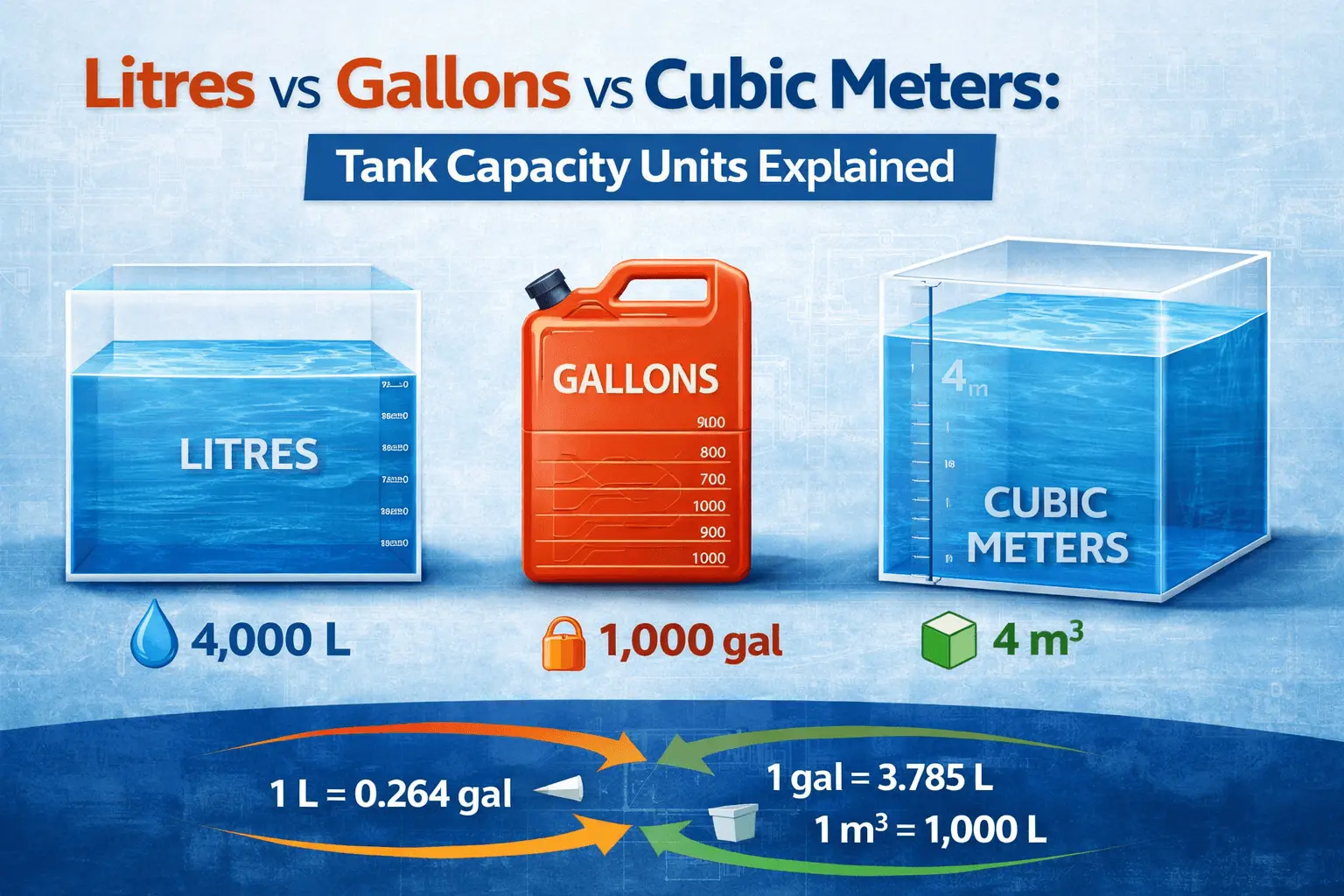
| 📐 This guide explains what each tank volume unit means, where it is used around the world, how to convert between them, and which unit to use for your specific tank application — with a complete quick-reference conversion table. |
Ask someone in Germany how big their water tank is, and they will say cubic meters. In the United States, the answer will be gallons, while in India or the UK, it is litres. This difference highlights the confusion around litres vs gallons vs cubic meters, even when describing the same tank capacity.
Tank capacity units vary by country, industry, and application. When you are ordering a replacement tank, comparing specifications from different manufacturers, calculating chemical dosing, or planning a fuel order, you need to know exactly which unit is being used and how to move between them accurately.
This guide explains litres, US gallons, Imperial gallons, and cubic meters in plain language — where each is used, what it looks like in real life, and how to convert between them without errors.
Why Different Tank Capacity Units Exist
Volume measurement has no single global standard. The metric system — which uses litres and cubic meters — is the official standard in most of the world under the International System of Units (SI). However, the United States still uses the US customary system, and the United Kingdom uses a combination of both metric and Imperial units depending on context.
In practice, this creates real confusion. A “500-gallon tank” means something different in the US versus the UK. A fuel order specified in gallons can be 20% wrong if the buyer and seller are on different gallon systems. A water treatment dosage calculated in litres produces a different result if someone assumes the tank is measured in Imperial gallons.
| Region | Primary Unit | Secondary Unit | Industry Notes |
| USA | US Gallons (gal) | Cubic feet (ft³) | Fuel, water, pools — gallons standard |
| UK | Litres (L) | Imperial gallons | Beer/milk: pints; fuel: litres; pools: gallons |
| EU / India / AUS | Litres (L) | Cubic meters (m³) | All sectors use metric exclusively |
| Oil & Gas (Global) | Barrels (bbl) | Cubic meters | 1 barrel = 158.987 litres |
| Agriculture (Global) | Litres or Gallons | Acre-feet (large) | Varies by country |
| Aviation (Global) | Litres or US Gallons | Kilograms (by weight) | Fuel sold by litres or kg |
Litres: The Global Standard for Water and Liquid Storage
| 💧 The Litre Symbol: L |
| 📍 Used in: Water storage tanks worldwide, domestic appliances, agricultural irrigation, swimming pools, aquariums, food and beverage manufacturing, pharmaceutical processing, water treatment plants, and everyday household measurement. 💡 1 litre of pure water weighs exactly 1 kilogram at 4°C — making litres and kilograms perfectly interchangeable for water weight calculations. |
The litre (spelled ‘liter’ in American English) is the most widely used volume unit for liquid storage globally. It is part of the metric system and derives directly from the cubic meter: 1 cubic meter contains exactly 1,000 litres. This clean, decimal relationship makes metric conversions straightforward and error-resistant.
In everyday terms, a litre is the size of a standard water bottle. A household bathroom tap running at full pressure delivers roughly 10–15 litres per minute. The average person uses 150–200 litres of water per day for drinking, cooking, and hygiene.
Litres in Real Tank Sizes
Understanding what litre capacities look like in real life helps you sense-check calculations:
Common Tank Sizes in Litres — Visual Scale
| Small household tank | ░░░░░░░░░░░░░░░░░░░░ | 500 L |
| Family water tank | █░░░░░░░░░░░░░░░░░░░ | 2,000 L |
| Farm storage tank | ████░░░░░░░░░░░░░░░░ | 10,000 L |
| Commercial water tank | ██████████░░░░░░░░░░ | 25,000 L |
| Industrial tank | ████████████████████ | 50,000 L |
| 💡 | Litre-to-weight shortcut for water Because 1 litre of water = 1 kg, you can instantly calculate the weight of a full water tank by reading its litre capacity. A 5,000-litre tank contains 5,000 kg (5 tonnes) of water when full. This is critical for structural load planning. |
→ Water Tank Volume Calculator (Litres) →
→ Cylindrical Water Tank Volume Calculator →
Gallons: US Gallon vs Imperial Gallon — A Critical Difference
| 🇺🇸 The US Gallon Symbol: US gal |
| 📍 Used in: All liquid storage in the United States: water tanks, fuel tanks, swimming pools, aquariums, agricultural irrigation, oil storage, paint, chemicals, and industrial processing. 💡 1 US gallon = 3.785 litres. The US gallon is used almost exclusively in the USA, Liberia, and Myanmar. |
| 🇬🇧 The Imperial Gallon Symbol: imp gal |
| 📍 Used in: Historically used across the UK, Canada, Australia, and Commonwealth countries. Still encountered in UK fuel contexts, marine applications, and older specifications. Most Commonwealth countries have fully transitioned to litres. 💡 1 Imperial gallon = 4.546 litres — approximately 20% larger than a US gallon. This difference causes significant errors when the wrong gallon is assumed. |
The gallon difference is one of the most frequently misunderstood unit distinctions in tank volume work. Because both are simply called ‘gallons’, it is easy to assume they are identical — but they are not.
| ⚠️ | The 20% Gallon Gap — A Real Cost A diesel tank ordered as ‘1,000 gallons’ in the USA holds 3,785 litres. The same ‘1,000 gallon’ order in the UK under Imperial measure holds 4,546 litres — a difference of 761 litres. At typical diesel prices, that is a significant financial discrepancy in any bulk fuel transaction. |
| Comparison | 🇺🇸 US Gallon | 🇬🇧 Imperial Gallon |
| 1 gallon = ? litres | 3.7854 litres | 4.5461 litres |
| 1 gallon = ? pints | 8 US pints | 8 Imperial pints |
| 500 gallons = ? L | 1,892.7 litres | 2,273.1 litres |
| 1,000 gallons = ? L | 3,785.4 litres | 4,546.1 litres |
| 5,000 gallons = ? L | 18,927 litres | 22,730 litres |
| Countries using it | USA, Liberia, Myanmar | UK (legacy), historical Commonwealth |
When to Use Gallons
- Purchasing or specifying tanks from US manufacturers — always confirm US gallons
- Aquarium sizing in the USA — fish tank sizes are universally listed in US gallons
- Fuel storage compliance documentation in US regulatory contexts
- Pool chemical dosing based on US gallon instructions
→ Fish Tank Volume Calculator (Feet & Gallons) →
→ Diesel Tank Volume Calculator →
→ Oil Tank Volume Calculator →
Cubic Meters: The Engineering and Industrial Standard
| ⚙️ The Cubic Meter Symbol: m³ |
| 📍 Used in: Civil engineering, industrial tank design, water treatment plants, sewage systems, chemical process vessels, large agricultural reservoirs, building services, HVAC systems, and all large-scale engineering specifications worldwide. 💡 1 cubic meter = 1,000 litres exactly. At 1,000 kg per cubic meter, a full water tank of 1 m³ weighs one metric tonne. |
The cubic meter is the SI base unit for volume and the standard used in engineering, construction, and large-scale industrial applications globally. Unlike litres or gallons, the cubic meter relates directly to linear dimensions: a cube that is exactly 1 meter on every side holds exactly 1 cubic meter of volume.
For smaller domestic tanks, cubic meters produce inconveniently small decimal numbers — a 500-litre household tank is 0.5 m³. This is why litres are preferred for domestic and light commercial applications, while cubic meters are standard for anything large-scale.
Cubic Meters in Real Engineering Terms
| Application | Typical Volume (m³) | Equivalent in Litres |
| Domestic overhead tank | 0.5 – 2 m³ | 500 – 2,000 L |
| Commercial building sump | 5 – 20 m³ | 5,000 – 20,000 L |
| Municipal water tank | 500 – 5,000 m³ | 500,000 – 5,000,000 L |
| Swimming pool (home) | 40 – 80 m³ | 40,000 – 80,000 L |
| Industrial process tank | 10 – 200 m³ | 10,000 – 200,000 L |
| Oil refinery storage | 5,000 – 50,000 m³ | 5M – 50M litres |
| 💡 | Why engineers prefer cubic meters Cubic meters connect directly to physical dimensions. A rectangular tank 2 m × 3 m × 1.5 m holds exactly 9 m³ = 9,000 litres. No conversion factors needed — the unit system is self-consistent from measurement to result. |
Worked Conversion Examples
The following examples show how to convert between units step by step, using realistic tank scenarios.
Example 1 — Water Tank: Litres to Cubic Meters and US Gallons
| Scenario: A cylindrical water tank holds 8,500 litres. Express this in cubic meters and US gallons. |
Step 1: Convert to cubic meters
8,500 ÷ 1,000 = 8.5 m³
Step 2: Convert to US gallons
8,500 × 0.2642 = 2,245.7 US gallons
| ✅ | Result: 8,500 L = 8.5 m³ = 2,245.7 US gallons = 1,870 Imperial gallons |
Example 2 — Fuel Tank: US Gallons to Litres and Cubic Meters
| Scenario: A diesel storage tank has a stated capacity of 2,500 US gallons. Convert to litres and m³. |
Step 1: Convert to litres
2,500 × 3.7854 = 9,463.5 litres
Step 2: Convert to cubic meters
9,463.5 ÷ 1,000 = 9.46 m³
| ✅ | Result: 2,500 US gallons = 9,463.5 litres = 9.46 m³ |
Example 3 — Industrial Tank: Cubic Meters to All Units
| Scenario: An industrial mixing vessel has a capacity of 15 m³. Convert to litres, US gallons, and Imperial gallons. |
15 m³ × 1,000 = 15,000 litres
15,000 × 0.2642 = 3,963 US gallons
15,000 × 0.2200 = 3,300 Imperial gallons
| ✅ | Result: 15 m³ = 15,000 L = 3,963 US gallons = 3,300 Imperial gallons |
Complete Quick Conversion Table — All Common Tank Volume Units
Bookmark this table or print it out for use at any time. It covers every conversion you are likely to need for tank capacity work — water, fuel, industrial, and agricultural applications.
| From → To | Multiply By | Reverse (÷) | Example |
| Litres → Cubic Meters | ÷ 1,000 | × 1,000 | 5,000 L ÷ 1,000 = 5 m³ |
| Cubic Meters → Litres | × 1,000 | ÷ 1,000 | 3.5 m³ × 1,000 = 3,500 L |
| Litres → US Gallons | × 0.2642 | ÷ 0.2642 | 1,000 L × 0.2642 = 264.2 gal |
| US Gallons → Litres | × 3.7854 | ÷ 3.7854 | 100 gal × 3.7854 = 378.5 L |
| Litres → Imperial Gal | × 0.2200 | ÷ 0.2200 | 1,000 L × 0.2200 = 220 gal |
| Imperial Gal → Litres | × 4.5461 | ÷ 4.5461 | 100 gal × 4.5461 = 454.6 L |
| US Gal → Imperial Gal | × 0.8327 | ÷ 0.8327 | 500 US gal × 0.8327 = 416.3 imp |
| Imperial Gal → US Gal | × 1.2009 | ÷ 1.2009 | 500 imp × 1.2009 = 600.5 US |
| Cubic Meters → US Gallons | × 264.17 | ÷ 264.17 | 2 m³ × 264.17 = 528.3 US gal |
| Cubic Feet → Litres | × 28.317 | ÷ 28.317 | 10 ft³ × 28.317 = 283.2 L |
| Cubic Feet → US Gallons | × 7.4805 | ÷ 7.4805 | 10 ft³ × 7.4805 = 74.8 US gal |
| Litres → Cubic Feet | × 0.03531 | ÷ 0.03531 | 1,000 L × 0.03531 = 35.3 ft³ |
| 🔗 | Skip manual conversions entirely Our free Tank Volume Converter supports litres, US gallons, Imperial gallons, cubic meters, cubic feet, and barrels — all in one tool with instant results. |
→ Tank Volume Unit Converter (Litres, Gallons, m³, Barrels) →
Which Unit Should You Use? A Practical Decision Guide
Choosing the right unit is less about preference and more about matching your context — the region, the industry, and the people you are communicating with.
| Your Situation | Recommended Unit | Why |
| Home water tank (global) | Litres (L) | Universal, easy to estimate weight |
| Engineering drawing / design | Cubic Meters (m³) | Consistent with SI dimensions |
| Aquarium (USA) | US Gallons | All US aquarium equipment rated in gal |
| Fuel tank (USA) | US Gallons | Fuel billing and pump ratings in US gal |
| Fuel tank (Europe/India) | Litres | Fuel sold by litre at pumps |
| Pool chemicals (USA) | US Gallons | All US product labels use US gallons |
| Industrial vessel spec | Cubic Meters (m³) | International engineering standard |
| Crude oil / bulk storage | Barrels (bbl) | Industry commodity standard |
For calculations, always use the same unit system throughout — litres and meters together, or feet and US gallons together. Never mix metric and imperial units in the same formula.
→ Main Tank Volume Calculator (All Shapes & Units) →
→ Horizontal Tank Volume Calculator →
→ Cylindrical Tank Volume Calculator →
Technical Reference
For the internationally recognised definition of SI units including the litre and cubic meter, refer to the Bureau International des Poids et Mesures (BIPM) — the authority that maintains the International System of Units:
BIPM — International System of Units (SI) | bipm.org
Frequently Asked Questions
Q: What is the difference between a US gallon and an Imperial gallon?
A US gallon equals 3.785 litres, while an Imperial (UK) gallon equals 4.546 litres — making the Imperial gallon approximately 20% larger. Both are called ‘gallons’ which causes frequent confusion. Always confirm which gallon system a specification uses before ordering, purchasing, or calculating chemical dosages.
Q: How many litres are in 1 cubic meter?
Exactly 1,000 litres. This is one of the most important conversions in tank volume work. To convert cubic meters to litres, multiply by 1,000. To convert litres to cubic meters, divide by 1,000. A 2.5 m³ tank holds 2,500 litres.
Q: How do I convert litres to US gallons?
Multiply the number of litres by 0.2642. For example, 5,000 litres × 0.2642 = 1,321 US gallons. To convert back from US gallons to litres, multiply by 3.7854. For example, 500 US gallons × 3.7854 = 1,892.7 litres.
Q: Why is the litre the most common tank unit worldwide?
The litre is part of the metric system, which is the official measurement standard for over 95% of the world’s countries. It has a direct, clean relationship to weight (1 litre of water = 1 kg) and to cubic meters (1 m³ = 1,000 L), making calculations simple and consistent. Most international trade, engineering, and scientific work uses the metric system.
Q: Which unit should I use for a water storage tank?
Use litres for most domestic and light commercial applications — it is the most universally understood unit for everyday water storage. Use cubic meters when working on engineering drawings or large-scale infrastructure. Use US gallons only if you are in the USA or working with US-manufactured equipment or US-based specifications.
Q: How many US gallons is a 1,000-litre tank?
1,000 litres × 0.2642 = 264.2 US gallons. Conversely, a 1,000 US gallon tank holds 1,000 × 3.7854 = 3,785.4 litres. These are very different sizes — 264 gallons versus 1,000 gallons — which illustrates why always specifying which unit you mean is so important.
Conclusion
Litres, gallons, and cubic meters are all valid ways to measure tank capacity — but they are not interchangeable without accurate conversion factors, and the two gallon systems differ by 20% from each other. Using the wrong unit, or assuming one gallon is the same as another, causes real errors in procurement, chemical dosing, fuel billing, and engineering design.
The rules to remember are simple: litres are the everyday global standard, cubic meters are the engineering standard for large volumes, US gallons are the US standard, and Imperial gallons are larger than US gallons by exactly 20%. When in doubt, always convert to litres first — it is the most universal reference point for liquid storage.
For instant, accurate conversions between all tank volume units — including litres, US gallons, Imperial gallons, cubic meters, cubic feet, and barrels — use our free tank volume converter. It eliminates manual conversion errors and works for every tank type and application.
| 🔗 Convert any tank volume unit instantly — free at Tank Volume Converter | Supports litres, gallons (US & Imperial), cubic meters, cubic feet, and barrels |