| ⚠️ Why This Article Matters A small error in tank volume calculation can mean thousands of litres of wasted capacity, costly overflow, wrong chemical dosing, or a dangerous pressure vessel sized for the wrong load. This guide covers the 5 most common mistakes with worked examples, a full correction checklist, and practical tips to get it right every time. |
Tank volume calculation looks straightforward on the surface plug in a few numbers, apply a formula, and you are done. In practice, it is one of the most error-prone tasks in engineering and everyday planning. The formulas are simple, but the inputs are where almost everyone goes wrong.
Whether you are sizing a home water tank, calculating fuel storage, planning an industrial vessel, or setting up an aquarium, even a 10% calculation error has real consequences. An undersized water tank runs dry during peak demand. An oversized fuel tank wastes capital and increases maintenance burden. An incorrectly calculated chemical dosing tank creates safety risks.
Top Mistakes When Calculating Tank Volume (And How to Avoid Them)
Here are the five most common tank volume mistakes — what causes them, what they cost, and exactly how to avoid them.
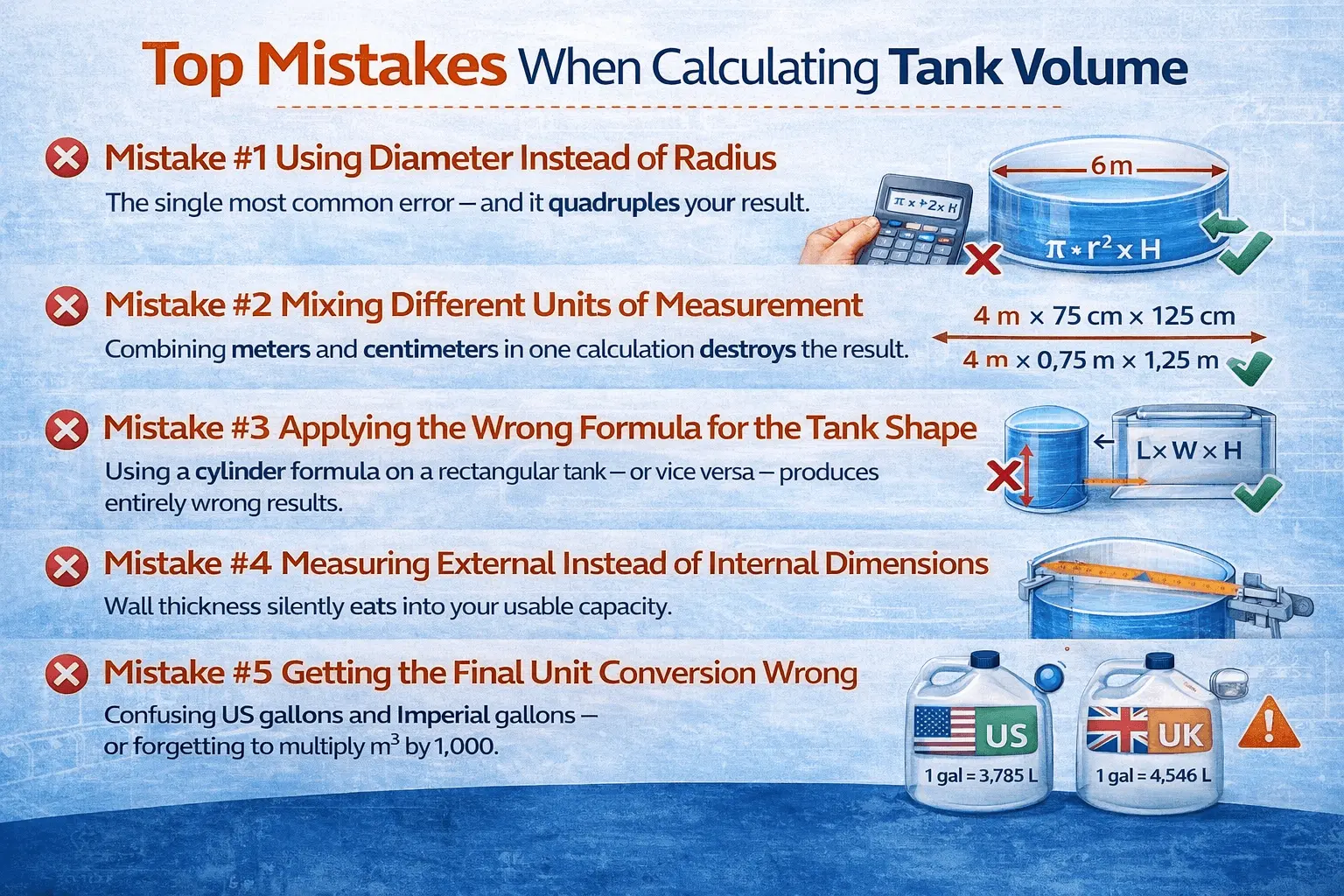
| ❌ Mistake #1 Using Diameter Instead of Radius The single most common error — and it quadruples your result. |
Every circular tank formula — cylindrical, horizontal, elliptical, capsule, and dish-end — uses radius (r), not diameter (D). Radius is half the diameter. If you measure across your tank and get 2 meters, your radius is 1 meter.
This sounds obvious written down, but under time pressure or when working from a manufacturer’s spec sheet listing diameter, it is incredibly easy to forget to halve the number before squaring it in the formula. Because the formula squares the radius (r²), entering the diameter directly does not just add a little extra — it gives you a result that is exactly four times too large.
| 📐 | Why the error is exactly 4× too large V = π × r² × h. If you enter D instead of r, you compute π × (2r)² × h = π × 4r² × h — which is 4 times the correct volume. A tank you calculated as 10,000 litres is actually 2,500 litres. |
Worked Example
| ❌ WRONG — diameter entered directly | ✅ CORRECT — radius used properly |
| Tank diameter = 2 m WRONG: r = 2 m ← (not halved) V = π × (2)² × 3 V = π × 4 × 3 = 37.70 m³ = 37,700 litres ← 4× too large | Tank diameter = 2 m CORRECT: r = 2 ÷ 2 = 1 m V = π × (1)² × 3 V = π × 1 × 3 = 9.42 m³ = 9,425 litres ← correct answer |
| ✅ | The Fix Always write ‘r = D ÷ 2 = ___’ as the very first step before touching any formula. Make it a non-negotiable habit. If your tank spec lists diameter, halve it immediately and cross out the diameter figure so you do not accidentally reuse it. |
→ Cylindrical Tank Volume Calculator →
→ Cylindrical Water Tank Volume Calculator →
| ❌ Mistake #2 Mixing Different Units of Measurement Combining meters and centimeters in one calculation destroys the result. |
Tank dimensions are measured in different units depending on the context. Manufacturer datasheets may list diameter in millimeters and height in meters. A site drawing might show length in feet while depth is given in inches. Older installations often mix imperial and metric. When you combine different units in the same formula without converting everything first, the result is completely meaningless.
| ⚠️ | A real-world example of unit mixing Height = 150 cm, Radius = 1 m. Without converting: V = π × (1)² × 150 = 471 m³ — a value absurdly large for any home tank. With correct conversion (150 cm = 1.5 m): V = π × (1)² × 1.5 = 4.71 m³ = 4,710 litres. The error was a factor of 100. |
Quick Unit Conversion Reference
| From | To | Multiply By |
| 1 meter (m) | centimeters (cm) | × 100 |
| 1 meter (m) | millimeters (mm) | × 1,000 |
| 1 foot (ft) | meters (m) | × 0.3048 |
| 1 inch (in) | centimeters (cm) | × 2.54 |
| 1 cubic meter (m³) | litres (L) | × 1,000 |
| 1 cubic foot (ft³) | litres (L) | × 28.317 |
| 1 US gallon | litres (L) | × 3.7854 |
| 1 Imperial gallon | litres (L) | × 4.5461 |
| ✅ | The Fix Before writing any formula, list every dimension and its unit. Convert all measurements to the same unit — meters is recommended for most engineering work, giving results in m³ that convert cleanly to litres by multiplying by 1,000. Use our unit converter tool for instant, error-free conversions. |
→ Tank Volume Unit Converter →
| ❌ Mistake #3 Applying the Wrong Formula for the Tank Shape Using a cylinder formula on a rectangular tank — or vice versa — produces entirely wrong results. |
There is no universal tank volume formula. Each tank shape has its own specific formula, and applying one shape’s formula to a different shape produces a result that has no relationship to the actual tank capacity. This error is surprisingly common because many people default to the cylinder formula as a “standard” and apply it to all tanks.
| Tank Shape | Correct Formula | Common Wrong Formula Used |
| Rectangular | V = L × W × H | V = π × r² × h (cylinder) |
| Horizontal Cylinder | V = π × r² × L | V = L × W × H (rectangle) |
| Elliptical | V = π × a × b × L | V = π × r² × L (circle radius only) |
| Capsule | V = π r²h + (4/3)π r³ | V = π × r² × h (cylinder only — misses end caps) |
| Dish End | Cylinder + end cap volumes | V = π × r² × L (cylinder only — misses dish ends) |
| ✅ | The Fix Always identify the tank shape before touching a formula. Walk around the tank or examine the technical drawing. If it has a circular cross-section, is it vertical or horizontal? Does it have flat or curved ends? Each answer changes which formula you use. When in doubt, use our shape-specific calculators below — they use the correct formula automatically. |
→ Horizontal Tank Volume Calculator →
→ Capsule Tank Volume Calculator →
→ Dish-End Tank Volume Calculator →
| ❌ Mistake #4 Measuring External Instead of Internal Dimensions Wall thickness silently eats into your usable capacity. |
Tank volume formulas calculate internal usable volume — the space actually available for liquid storage. But when you take a tape measure to a tank, the most natural thing to measure is the outside. For thin-walled plastic or stainless steel tanks, this barely matters. For thick-walled concrete cisterns, heavily reinforced underground tanks, or insulated industrial vessels, external dimensions can overstate actual capacity by a significant margin.
| ❌ Using External Dimensions | ✅ Using Internal Dimensions |
| External diameter: 2.0 m Wall thickness: 0.15 m each side Using external r = 1.0 m V = π × (1.0)² × 3 = 9.42 m³ = 9,425 litres ← OVERSTATED | Internal diameter: 2.0 − (2×0.15) = 1.7 m Internal r = 0.85 m V = π × (0.85)² × 3 = 6.81 m³ = 6,810 litres ← ACTUAL CAPACITY |
In this example, ignoring 150 mm concrete walls on each side overstates capacity by 2,615 litres — nearly 28% more than the tank can actually hold. For a farm irrigation system or industrial process tank, this kind of error directly affects operational planning.
| ✅ | The Fix Always measure internal dimensions — reach inside with a tape measure, or subtract known wall thickness from external measurements. Check manufacturer datasheets: most reputable tank suppliers list internal usable capacity directly, which removes all guesswork. |
→ Oil Tank Volume Calculator →
→ Diesel Tank Volume Calculator →
| ❌ Mistake #5 Getting the Final Unit Conversion Wrong Confusing US gallons and Imperial gallons — or forgetting to multiply m³ by 1,000. |
The calculation itself may be perfect, but the final step of converting the result into a useful unit is where many people make a critical error. There are three particularly common conversion mistakes:
Error A: Forgetting to Convert Cubic Meters to Litres
The formula V = π × r² × h gives the result in cubic meters when dimensions are in meters. 1 m³ = 1,000 litres. Treating the result as litres directly — a factor of 1,000 error — is surprisingly common, especially when someone expects a result in the thousands and sees a small decimal number.
Error B: Confusing US Gallons and Imperial Gallons
| ⚠️ | US Gallon ≠ Imperial Gallon 1 US gallon = 3.785 litres. 1 Imperial (UK) gallon = 4.546 litres. That is a 20% difference. A tank you calculated as 500 US gallons holds 1,893 litres — but 500 Imperial gallons holds 2,273 litres. In fuel billing, procurement, and chemical dosing, this 380-litre gap has real financial and safety consequences. |
Error C: Cubic Feet to Gallons — Which Gallon?
1 cubic foot = 7.481 US gallons, or 6.229 Imperial gallons. Using the wrong gallon type after a cubic-foot calculation compounds both errors — shape formula result and unit system — into a result that can be off by 20% or more.
| ✅ | The Fix Always state the full unit at every step: write ‘9.42 m³’ not just ‘9.42’. Then apply the conversion explicitly: 9.42 m³ × 1,000 = 9,420 litres. When working in gallons, confirm whether the specification requires US or Imperial gallons before calculating. Use our unit converter to switch between all volume units instantly. |
→ Tank Volume Unit Converter (Litres, Gallons, m³, Barrels) →
→ Fish Tank Volume Calculator (Feet) →
Master Checklist: Get Your Tank Volume Right Every Time
Print this checklist or save it to your phone. Run through every item before finalising any tank volume calculation — whether it is for a home water tank, a fuel store, an industrial vessel, or an aquarium.
| 📋 BEFORE You Calculate — Measurement Checklist |
| ☐ Identified the correct tank shape (vertical cylinder / horizontal cylinder / rectangular / elliptical / capsule / dish-end) ☐ Measured internal dimensions — not external ☐ Recorded the diameter — then immediately calculated r = D ÷ 2 ☐ Confirmed all dimensions are in the same unit (meters, feet, or inches — not mixed) ☐ Noted whether the tank has any curved ends, dish ends, or hemispherical caps that add extra volume ☐ Checked the manufacturer datasheet for internal capacity if available |
| 🔢 DURING Calculation — Formula Checklist |
| ☐ Selected the correct formula for the identified tank shape ☐ Used radius (r), not diameter, in every formula ☐ Written every unit alongside every number (e.g. 1.5 m, not just 1.5) ☐ For capsule or dish-end tanks: calculated cylindrical body and end caps separately, then added them ☐ Double-checked arithmetic by estimating the rough expected result before calculating exactly ☐ Verified the formula output unit matches the input units (m inputs → m³ result) |
| ✅ AFTER Calculation — Conversion and Sense-Check Checklist |
| ☐ Converted m³ to litres by multiplying by 1,000 (or ft³ to litres by multiplying by 28.317) ☐ Confirmed whether gallons required are US gallons (×3.785) or Imperial gallons (×4.546) ☐ Sense-checked the result: does the number feel right for the tank’s physical size? ☐ Compared against manufacturer-stated capacity if available — within 5% is acceptable ☐ For fuel tanks: applied 90% safe fill rule (multiply total by 0.9 for usable capacity) ☐ Recorded the final result with units clearly stated for future reference |
The Easiest Way to Avoid All Five Mistakes
Even experienced engineers use calculators rather than working from formulas by hand for every job — not because the math is difficult, but because manual calculation introduces transcription errors, unit-mixing risks, and formula-selection uncertainty that calculators eliminate entirely.
Our free tank volume calculators handle the correct formula for each shape automatically, accept inputs in your preferred units, and output results in litres, US gallons, Imperial gallons, cubic meters, and cubic feet simultaneously — removing every source of human error covered in this article.
| 🔗 Free Tank Volume Calculators — Use the Right Tool for Your Tank ✔ Main Calculator — All Tank Shapes ✔ Cylindrical Tank Calculator ✔ Horizontal Tank Calculator ✔ Capsule Tank Calculator ✔ Dish-End Tank Calculator ✔ Tank Volume Unit Converter |
Further Reading
For internationally recognised standards on measurement accuracy and unit systems used in engineering and industry, refer to the National Institute of Standards and Technology (NIST):
NIST — SI Units and Measurement Standards (nist.gov)
Frequently Asked Questions
Q: What is the most common mistake in tank volume calculation?
A: Using diameter instead of radius in circular tank formulas. Every formula for cylindrical, horizontal, elliptical, capsule, and dish-end tanks requires the radius — which is half the diameter. Entering the full diameter directly produces a result that is exactly four times the correct volume. Always halve the diameter first and write r = D ÷ 2 before starting any calculation.
Q: Why does mixing metric and imperial units give wrong results?
A: Volume formulas require every dimension to be in the same unit. If you enter height in centimeters and radius in meters without converting, you are effectively multiplying values from different scales together. The result has no physical meaning. Always convert all measurements to a single unit — preferably meters for metric work — before applying any formula.
Q: Does it matter if I use US gallons or Imperial gallons?
A: Yes — significantly. A US gallon is 3.785 litres and an Imperial gallon is 4.546 litres, a difference of approximately 20%. For large tanks, this translates to hundreds or thousands of litres of discrepancy. Always confirm which gallon system applies to your region and specification before converting.
Q: How do I check if my tank volume calculation is correct?
A: Three approaches: (1) Compare with the manufacturer’s stated capacity — your result should be within 5%. (2) Estimate the result before calculating and check your answer is in the right ballpark. (3) Use a shape-specific online calculator and compare results. If your manual calculation and the calculator agree, you can be confident in the answer.
Q: Should I measure the inside or outside of a tank?
A: Always measure inside (internal) dimensions. Tank volume formulas calculate the internal usable space. External measurements include wall thickness, which does not hold liquid. For thin plastic tanks this difference is negligible, but for concrete, reinforced, or insulated tanks, wall thickness can reduce usable capacity by 10–30%.
Q: Why is my calculated tank volume different from what the manufacturer states?
A: The most likely causes are: measuring external instead of internal dimensions, using an incorrect formula for the tank shape, applying the wrong units, or for fuel tanks — not accounting for the 10% ullage space (empty headroom) that manufacturers exclude from ‘usable’ capacity. For dish-end and capsule tanks, forgetting to include the end cap volume also leads to underestimation.
Conclusion
The five mistakes covered in this guide — using diameter instead of radius, mixing units, applying the wrong formula for the tank shape, measuring external dimensions, and getting the final unit conversion wrong — account for the vast majority of tank volume calculation errors made by homeowners, engineers, and industry professionals alike.
Each mistake is entirely avoidable. The master checklist above gives you a clear, step-by-step process to follow for every calculation. The rule is simple: slow down, label every number with its unit, halve the diameter before it goes near a formula, identify the shape before selecting a formula, and always measure from the inside.
For any tank shape, our free online calculators handle all the formulas automatically and output results in every common unit — eliminating the most common sources of error in one step.
| 🔗 Skip the manual errors entirely – use our free Tank Volume Calculator at tankvolume-calculator.com for instant, accurate results across every tank shape and unit system. |